Battery Energy Storage System (BESS): Buyer’s Guide
A battery energy storage system (BESS) combines batteries, power conversion, controls, thermal and safety equipment and often PV into an integrated plant. Selection starts with the load profile, backup hours, cycling duty, site conditions and whether the site runs grid-tied, hybrid or off-grid.
What a Battery Energy Storage System Includes
Energy storage systems are shaped by where they sit and what they must do. Behind-the-meter commercial and industrial systems serve a customer site, sharing capacity between load shifting, demand control and backup. Utility-scale systems aggregate battery blocks for grid services. Off-grid systems carry the whole site load, while hybrid systems blend PV, batteries and often a generator. Battery bank, power conversion, controls and safety equipment differ in each case, and the configuration follows load, backup and cycling needs rather than a fixed template applied to every site.
A solar energy storage system moves energy from PV modules through an inverter or charge controller into the battery, then out to loads or a backup circuit. In a grid-tied arrangement the site can exchange energy with the grid; off-grid systems carry the load alone; hybrid systems do both and switch between sources by setting. Sizing inputs are practical: daily energy use, peak load, the backup hours the site needs, PV yield at the location, usable battery capacity, and the power and phase of the conversion equipment.
A battery storage system is the battery bank plus the power conversion, controls and safety equipment that let it charge, discharge and disconnect safely. Commercial sites use it for load shifting and demand control, industrial plants use it to ride through interruptions, off-grid sites use it as the main supply, and backup systems keep critical circuits live. Capacity, voltage and inverter power are matched to the load and to the duty cycle the site will actually run.
ESS battery selection turns on chemistry, voltage and capacity, the cycle duty the site will run, the battery management system, and the cabinet or container format, together with thermal management and safety provisions. LFP chemistry is common where daily cycling and thermal stability matter. Parameters do not transfer between projects: a commercial energy storage cabinet and a containerised plant are specified differently. Send the load list, site location and quantity, and Mars Solar configures the battery format with the rest of the system.
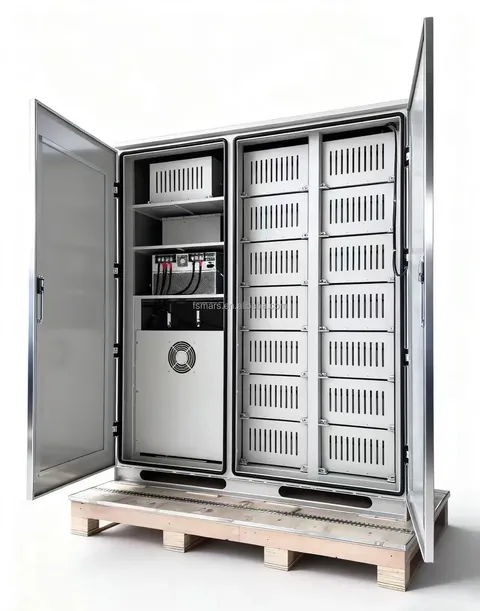
Open cabinet with stacked modules on pallet 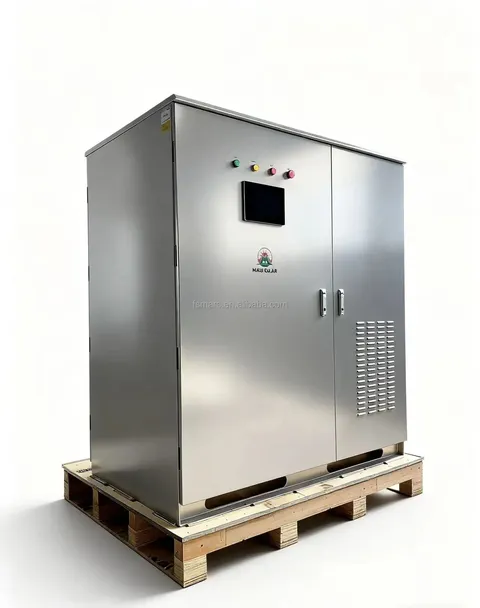
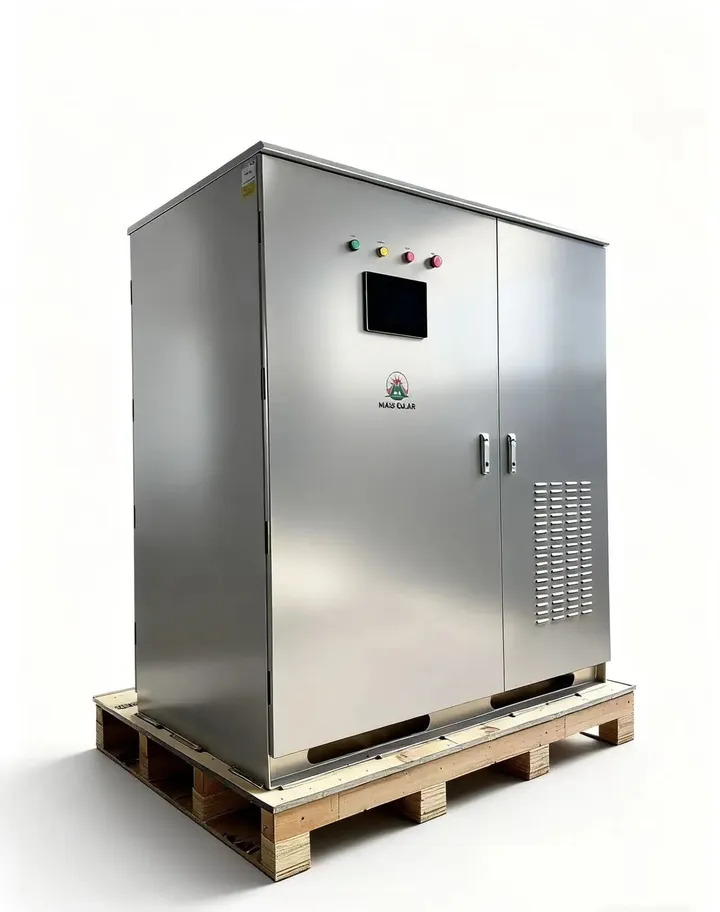
Closed steel cabinet with front display
How Mars Solar Configures and Supplies a Storage Project
Mars Solar is a system supplier and integrator of solar and battery storage systems. Mars Solar supplies pre-engineered solar-plus-storage configurations and the equipment inside them: PV modules, hybrid converters and PCS, LFP battery cabinets and the balance of system. Batteries, hybrid inverters and PV modules are also supplied individually for integrators who already have a design.
Reference configurations are 100 kW PV / 215 kWh and 125 kW PV / 261 kWh. The 100 kW / 215 kWh configuration pairs 100 kW of PV with a 100 kW hybrid converter and a 215 kWh battery, and whether PV is included is set in the quotation. Anonymised references include a hotel project in Nigeria at 250 kW PV with storage included, shipped; a cold storage project in the Philippines at 135 kW PV with storage on request, commissioned; and a farm and agriculture project in Zimbabwe at 1 MW PV and 2 MWh storage, designed. Commercial and utility-scale sites use battery storage containers.
- Send the load list, site location and quantity.
- Receive a configuration proposal and a quotation on FOB, CIF or EXW terms.
- Approve a sample where the project requires it.
- Equipment is tested before shipment.
Minimum order quantity is confirmed per product, and some listings start from 1 piece or 1 set. Average lead time is about one month in peak season and within 15 workdays in off season, with the exact delivery window confirmed once the configuration is fixed. Payment is by T/T, with PayPal, Western Union and MoneyGram also available and confirmed per order. OEM/ODM service, customization on demand and sample processing are offered, and Mars Solar replies to enquiries within one working day.
Testing, Documentation and Support After Shipment
Test items are performed and recorded before shipment. The supply contract defines the tests and documents, and a typical documentation set includes a test record, an as-built configuration table and equipment datasheets. Mars Solar’s facility has 3,625 m² of floor space and 3 QA/QC inspectors. Warranty is set per component, so panel, inverter and battery each carry their own terms, confirmed with the order.
For the 100 kW / 215 kWh configuration, commissioning support and remote diagnosis are included in technical support, and critical spares can ship with the main order. If the project needs it, Mars Solar can send an engineer to the customer’s country to guide installation; the service applies to the 100 kW / 215 kWh configuration and is quoted separately where it can legally be provided. Civil works, local installation labour and utility interconnection are excluded by default.
Mars Solar has exported to more than 130 countries and regions, with main markets in North America, South America, Eastern and Western Europe, Southeast and East Asia, Africa, Oceania and the Middle East, and has supplied systems into West Africa, Southeast Asia and East Africa. Agents in Africa, the Middle East and Asia support after-sales service. Mars Solar started exporting in 2008; the foreign trade team is 21–50 people and the export percentage is more than 90%.
Coverage of a specific model under the CE certificates is confirmed with the quotation.
Request a quotation
Describe your site, loads and backup needs, and we will propose a matching Mars Solar configuration.
Or write to sales@solarkitsupplier.com